
Now we come to the final piece of the painting triforce: brushes. Without brushes, you’re just dipping figures in paint, and that won’t look very nice at all, will it? No, of course it won’t, unless you’re dipping for a quickshade and that’s a whole ‘nother technique in and of itself.
But I digress.
Brushes are one of the areas that can feel as overwhelming as paints, but if you take a breath, break it down, and take your time going over your options, you’ll be just fine. You don’t need expensive kolinsky sable brushes (although they are very nice) to get started in your career of okay mini painting, but you do want to keep a few things in mind.
First, as with the craft paints, you probably want to stay away from any bulk cheap brush sets that offer 20+ brushes (most of which you won’t actually need) for not much money. Like the craft paints, they may seem very tempting, but you will get what you pay for. You’ll notice these brushes won’t hold their points after a while, and while this can be useful for drybrushing, the bristles will eventually fall out as the ferrule (the metal collar that holds the bristles on the handle) becomes looser. These brushes are generally not designed to hold up under repeated use, so you’ll end up replacing them more often. HOWEVER if you’re building terrain and need to cover a lot of surface area quickly, the larger brushes in these sets are perfectly serviceable. Terrain building doesn’t require nearly the same type of precision use, so you can get away with these brushes for that purpose.
Second, you’ll definitely want to learn and practice good brush habits. Depending on the quality of your brushes, taking care of them properly will mean anything from adding years onto their life to preserving them indefinitely. These include:
- Store them tip-down with the plastic cap on to prevent moisture from wicking paint into the ferrule
- Never leaving them in your water glass overnight
- Keeping paint out of the ferrule
- Never splaying the bristles against the bottom of your water glass
- Always washing the paint out of the bristles when you’re done
- Washing them frequently with brush soap
These practices should go a long way to help preserve your brushes and keep you from having to retire them to drybrushing duty before their time.
Third, you don’t need a lot of fancy shapes and sizes. You’re not going to need a fan brush or a weird wedge shape to get paint on a mini. In fact, you don’t need very many different sizes and shapes at all. You’ll want a medium round brush (size 0), a 3/0 or 5/0 small detail brush, and a small flat brush for large open surfaces. In a pinch, you could go with just the 0 brush and paint to your heart’s content. As you learn and grow in the hobby, though, you’ll start to get more comfortable with the different kind of brushes you can use and how to use them; buying a brush specifically designed for drybrushing can serve you better than waiting for your primary basecoat brush to age out of that role.
So where should you start? Well, as with paint, there are a few places you can go for a good, inexpensive start.
REAPER
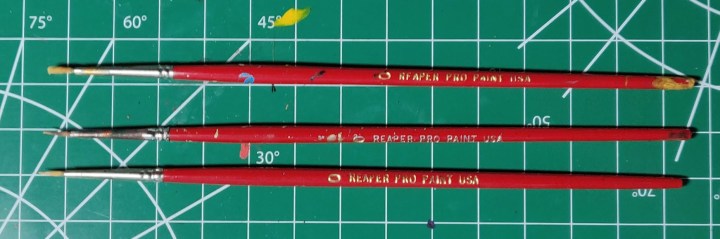
Reaper makes an excellent and affordable series of hobby brushes that you really can’t go wrong with. They hold up well to normal use, and you can expect to get a long life out of them, if you take care of them. The brushes you see above use a synthetic fiber called taklon, which is a polyester designed to mimic the qualities of various natural fibers (usually sable, although you can find taklon made to emulate boar bristle). These brushes are in different stages of life, but they all have years of work left in them. Reaper also offers kolinsky sable brushes, if you’d like to try natural fibers. These brushes have good points, and will handle coverage and detail work easily.
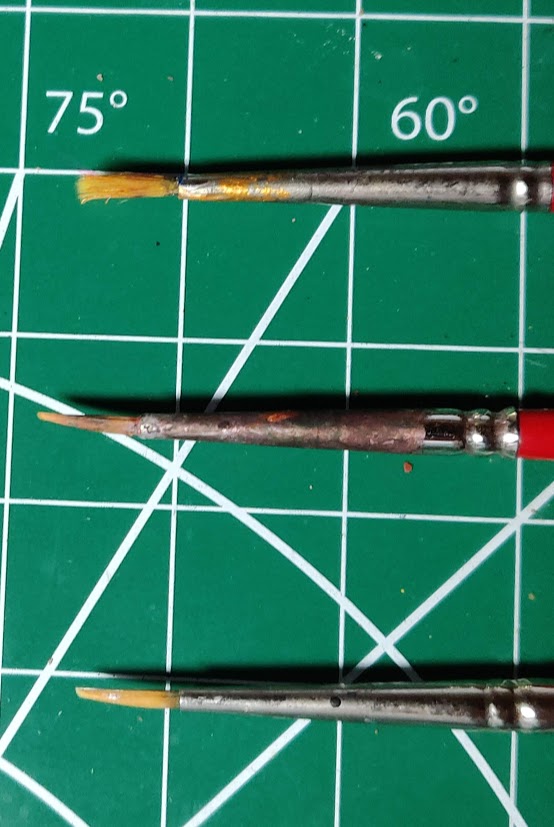
These are all the same size brushes, but due to regular use you can see that they are slightly different. The one on top is the oldest, and though it has been cared for well, time has caused the bristles to fray and splay out a bit. That’s fine! That just means you’ll be using this brush for heavy duty work like drybrushing (which is rough on brushes), detail work like stippling, or even brushing on primer (though I’d use a bigger brush, honestly). The prices range from $6/brush-$15/set of three for the taklon synthetic brushes, to about $12 for a sable brush. Overall, Reaper offers durable, good quality brushes that are a great place for a beginner to start.
ARMY PAINTER
Army Painter’s brushes are another good mid-range line to start with. They offer two series: Wargaming and Hobby. Wargaming brushes have triangular handles for ease of use, and are sized by role (Regiment, Detail, Insane Detail). They’re fitted with fiber based on the role, with most having natural sable. They have a nice point, although I did have to trim mine slightly. The bristles on mine tend to frizz if you don’t shape them before they dry, but overall, it’s a good solid brush
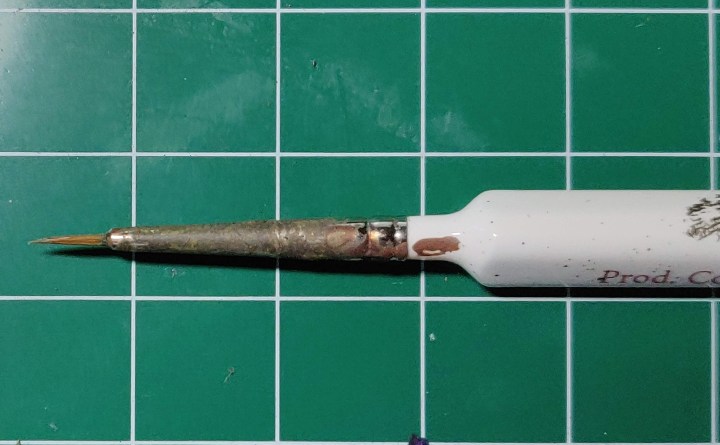
The Hobby line is a good place for beginners to start, but as I have no personal experience with them, can’t give any opinions one way or the other. Hobby brushes run about $4-5, versus Wargaming’s $7, so not a huge difference in price if you want to go ahead and get the Wargaming brushes. Army Painter also offers a kolinsky sable Masterclass brush for around $10, so if you want to try that fiber out, this is a good place to start. Like Reaper, Army Painter brushes are good, solid, affordable workhorses that will give you a lot of mileage if you take care of them properly.
PRIVATEER P3
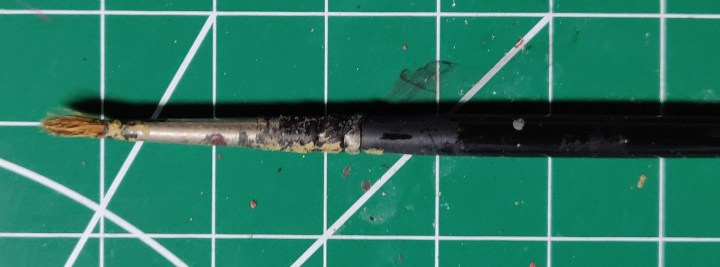
Privateer has a line of P3 brushes to go with its P3 paints, and I’ve only ever used one (pictured above). It’s labeled as a Work Studio brush, so I would expect it to be another general purpose brush like the Army Painter Detail brush, or Reaper’s 0 brush, but I find it best suited to priming and drybrushing. I’ve also had this brush for years, so the quality may have changed since. Unfortunately, I haven’t had much experience with P3 brushes, so personally I’d go with Reaper or Army Painter, but feel free to experiment! A P3 Medium Hobby brush is only about $9, so you won’t go broke if you want to try it. Usually, if a brush won’t work for what you bought it for, you’ll find another suitable job for it (like drybrushing!) so it’s very rarely a waste of money to try one out.
CITADEL
I have exactly one Citadel brush and I don’t like it very much. Still, it’s fine for priming and drybrushing, but I won’t be doing anything else with it. Like the P3 brush, it is years old, so their lines may have improved recently. If you want to try out the line, feel free, but I much prefer Citadel’s paints over their brushes.
ART BRUSHES
These are brands like Winsor & Newton, Loew-Cornell, and Grumbacher. They are good- to high-quality brushes, based on which line you look at, and they can be expensive, although their prices will generally be in-line with the brushes sold by the various hobby companies. They will offer a lot more varieties, so you’ll want to hold off on looking at these brands until you’re comfortable with painting and know exactly what you’ll be needing the brush for. Another thing to mention is painters have noticed a bit of a drop in quality for Winsor & Newton recently, so you may want to go with Grumbacher or Loew-Cornell. Once you’re comfortable branching out, these brushes will be excellent additions to your arsenal.
KEEPING IT CLEAN

One thing you will definitely want to get very early on is brush soap. This will do wonders in extending the life of your brushes. Cleaning them out with water at the end of your session is great, but if you have time, brush soap is always a good option. At the very least, you want to give each of your brushes a good washing about once a week or so. In addition to helping get rid of any paint, medium, or other residue that the water may miss, the soap will help shape and condition the bristles. Just wet your brush with warm water, swish it around in the soap, and rinse off. If you notice your brush starting to lose its shape, you can shape the brush against the soap after rinsing, and just leave the second layer to dry on the brush. It will help condition and reshape the brush as it dries. It works with synthetic and natural bristles, and should be one of your first purchases.
So that’s mostly it for brushes. It’s a little more complex than paint, but very forgiving. It’s hard to go wrong with a brush, because, at the very least, you have a new primer/drybrushing brush, even if it doesn’t work out for what you intended it for. Overall, though, I recommend starting with Reaper’s 0 Round, and branching out from there. That’s more than enough to get you painting okay minis that look great on the table.
Happy painting!
 The Okay Tabletop