
So we’ve talked about paints, brushes, palettes, and workspaces. I’ve given you a rundown of what you need to get started. Now it’s time to get some paint on a mini. What I’m going to do is paint a Bones figure using just the basic colors shown in the Paint post. It’s going to be fun, it’s going to be simple, and most importantly, it’s going to be okay. One note: I’m using only Vallejo paints in this project, instead of the mix of Vallejo and Army Painter that I used in the post, because I’ll be mixing a couple of colors, and you’ll want to mix brand-to-brand. I’m also painting this one right out of the pack, instead of washing it first, to demonstrate Reaper’s point about being ready to go right from the point of purchase. In that regard, using the Black Surface Primer is an aesthetic choice, not one of necessity; if you prefer white primer, just go ahead and start painting. (Though if you do notice the paint is beading, washing the figure with dish soap and a toothbrush will correct this; some figures may have a film of mold release that will keep the paint from sticking.)
So, without further ado, here is the list of colors we’ll be using:
- Dead White
- Black
- Dark Green
- Earth
- Sun Yellow
- Magic Blue
- Gory Red
- Polished Gold
- Silver
- Smokey Ink
- Black Surface Primer
And here is the figure we’re going to be painting:
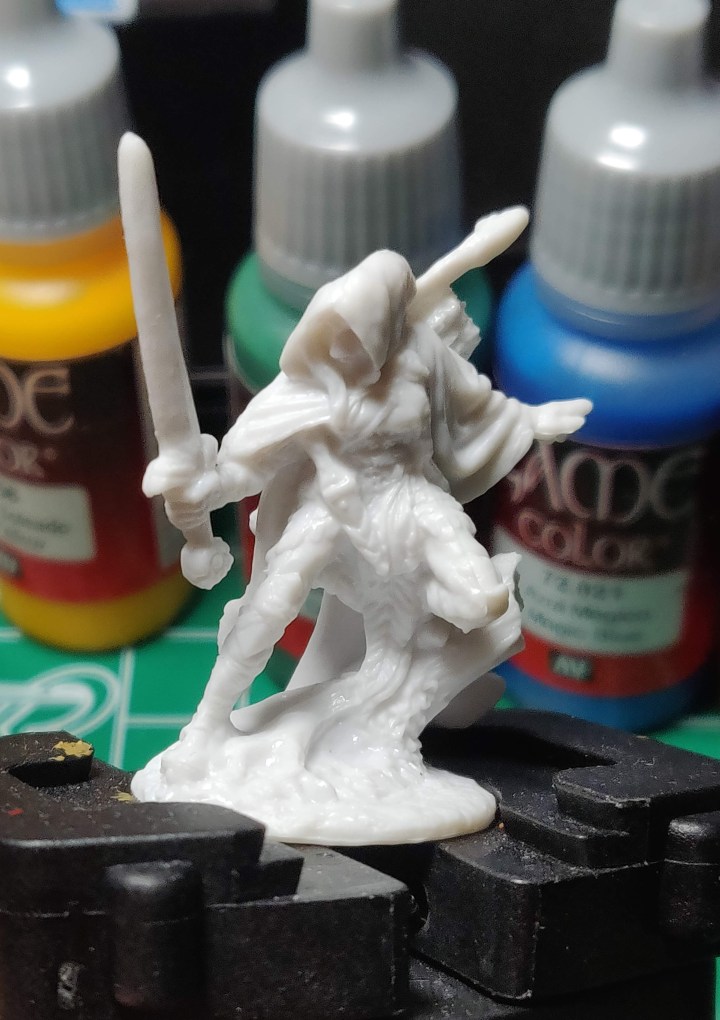
Remember Nienna? We’re going to paint her as simply and quickly as we can, and when we’re done, we’re going to have a mini that’s going to look great on the tabletop. One thing we’re not going to do, though, is half-ass her paint job. Okay minis are not sloppy, or rushed, or painted without care. Okay minis are just that: okay. But you have permission to be okay.
STEP 1: PRIMER
For this one, we’re going to jump right to the primer coat. This step is not strictly necessary with Bones figures; they’re designed to take paint right on the white, and if you prime with white, you may feel comfortable enough doing so. As I’ve said, if you try this and notice the paint beading up on you, just wash it in warm water with dish soap and a soft toothbrush. As it is, one of the shortcuts to finishing your mini in a reasonable amount of time is priming in black, as it can help fill in gaps that might arise from painting, so that’s what I’ve done here. Using a primer will help the paint stick, and a darker primer yields a richer, deeper color. For Nienna, I’ve used Vallejo’s Black Surface primer, brushed on with my P3 studio brush. It did at times bead up, but the primer is thick enough that a heavier layer will overcome this. Just take care not to be too heavy-handed; it’s easy to obscure detail with too much primer. Also, the primer doesn’t necessarily need to be thinned like your paints; it’s designed to cover, so thinning may defeat that purpose. About the only time I thin primer is if I’m covering a large flat surface and I notice brush strokes. Your mileage may vary, and if you’re comfortable thinning the primer, then go right ahead. There are very few wrong answers when it comes to painting, and what works for me may not work for you.
This is what she looked like once the primer dried:


It dried smooth, but not so smooth that the paint won’t have something to grab onto. this, plus the texture of the mini itself, offers a great surface for the paint to adhere to. This is probably the simplest step, and the one you’ll have the most fun with, if you were a kid like me who just loved seeing paint fill areas on the paper.
STEP 2: BASECOAT
Basecoating is simply laying down the main colors on the figure. It’s easy to get bogged down at this point, but if you keep your palette simple, you can cut through a lot of the analysis paralysis that I used to get caught up in. Picking one or two main colors, and one or two accent colors is a very good approach this early on. Picking colors that contrast is also a good practice, because contrasting colors can naturally add emphasis to each other and break up otherwise monotonous areas of a single color. I’ve picked Dark Green and Earth for my main color because these are two colors that work very well together, and I’ve chosen Gory Red and Sun Yellow as my accent colors because they both contrast excellently with the Dark Green. Red and green are perfect contrasts because they are opposite each other on the color wheel, which we’ll get to.
For her flesh tone, I started with Earth, added Bone White until I got a nice light tan, then added just a touch of Gory Red. That gives a nice light tone that works well for elves. One of the challenges I’ll be setting for myself is painting darker flesh tones, too, but we’ll be using a darker flesh base for that. For now, we’re just seeing what we can do with the basic colors I’ve assembled.
After applying the basecoat, this is what I’ve got:


She’s starting to come together, but as you can see, she looks a little flat. That’s what the next step is for.
STEP 3: THE WASH
Washes are thin inks that are designed to run off the raised areas of a figure and into the deeper recesses. Since darks appear to recede, this helps create deeper shadows on the figures, and helps complete the illusion of depth. As you get more comfortable with working with them, you’ll be able to pick and choose washes based on the colors you’re working with, or know when to use one simple wash. Army Painter’s Strong Tone, for example, is an excellent all-purpose wash that can be used on the whole of many figures, which is a huge time saver if you have a lot of figures to paint. In fact, it’s designed to do so. But you can also use a number of different Flesh Washes on skin tones, Red, Blue, and Greeen tones, on corresponding colors, Armor washes on metals, Sepia washes on golds and bronzes, and so on. Washes can hold varying amounts of pigment, and usually can be differentiated by a “strong”, “heavy”, or “soft” designation. Secret Weapon’s Soft Body Black and Heavy Body Black are both black washes, but one will have a bolder shade than the other.


For Nienna, I’ve taken Smokey Ink, and thinned it at about a 2:3 ratio, paint to water. I then painted it on the entire figure. You can see where it pooled in the recesses and left a darker brown. It’s especially noticeable on her face, where it’s helping add depth to the lighter flesh tone. This casting had some smoothed-off features on the face, so the wash is essential for helping pick out the details that might otherwise be missed. I chose the Smokey Ink for two reasons: one, because I wanted to keep everything on Nienna the same brand to facilitate mixing, and two, because she’s a ranger, the brown wash feels more natural, and will help bring the figure together. You can see how the detail has really started to stand out, especially on the base and in the deep recesses of the cloak. At this point, you’d be perfectly fine calling her done and putting her on the table, especially if she’s an NPC. But there’s one more step we can finish if we want to make the details pop.
STEP 4: HIGHLIGHTING
Highlighting is generally the last step for most casual painters. There are a couple of things you can do after highlighting (like glazes), but generally, once you’ve done your highlights, you’re pretty much done. This is also the step where you are most likely to overwork the figure, so it’s best to keep things very simple here; generally one level of highlighting is fine, two if you really want to make it pop. I used to spend a lot of time and paint gradually building up highlights until I had ten or more levels, but unless you’re entering a contest, there’s no need to be quite so meticulous. Even painting a centerpiece for an army doesn’t need that much attention paid to getting the highlight gradient just right. Highlighting at its most simple is just going back over the raised parts of the figure with the basecoat. That’s it. That’s the part that will make the colors stand out against the wash you’ve put on. If you want to take things to the next level, you can go one shade lighter, and hit the very highest parts of the figure. If you want to do this here’s something to keep in mind when lightening your basecoats:
For reds, oranges, yellows, and greens, add yellow to your basecoat to lighten it. White will tend to wash the color out, or change the color entirely (red to pink, for example). For blues and purples, white will work fine. Browns can be lightened with white or yellow, based on how the basecoat is tinted to start with.


For Nienna, I kept the highlights muted; she is a ranger after all, so I wanted to keep her looking like she is sticking to the shadows. Of course, the opposite is also an option, being a ranger, she is likely outdoors often, so adding a dash of yellow to her cloak and bow can give the impression of sunlight through the trees. Try it, and see how different she’ll look. All I did to add them was paint them on like I did the basecoat, with the same brush. You can, of course, use a smaller one, if you have one, but the point of this entry is to show that you can paint a perfectly okay mini with one brush and just a few paints.
PARTING THOUGHTS

Nienna took only a few hours to paint; I finished her over the course of a couple of evenings. But she’s a figure that will look great when I place her on the table with scenery, and a group of figures to back her up. She won’t be winning any painting contests, but she’s an Okay mini, to be sure. Once you feel more comfortable with the whole process, you can start taking more time with your figures, and learning more techniques to challenge yourself. Remember, just because you have permission to be Okay does not mean you have permission to be lazy, or to half-ass your paint jobs. You should always do the best you can, just keep in mind that Okay finished minis are one thousand percent better than Perfect unfinished ones.
Happy painting!
 The Okay Tabletop
One thought on “Let’s Paint”